Warehouse IT Setup & Support in Japan — Greenfield to Go-Live
Bilingual IT for warehouse builds, moves, expansions, and ERP integration
On this page 5
Warehouse IT, End to End
- Project management and task-force coordination
- Wi-Fi survey, structured cabling, machine room
- PCs, barcode scanners, and label printers
- EDI connection to your ERP and shippers
A Warehouse Is Its Own Kind of IT Project
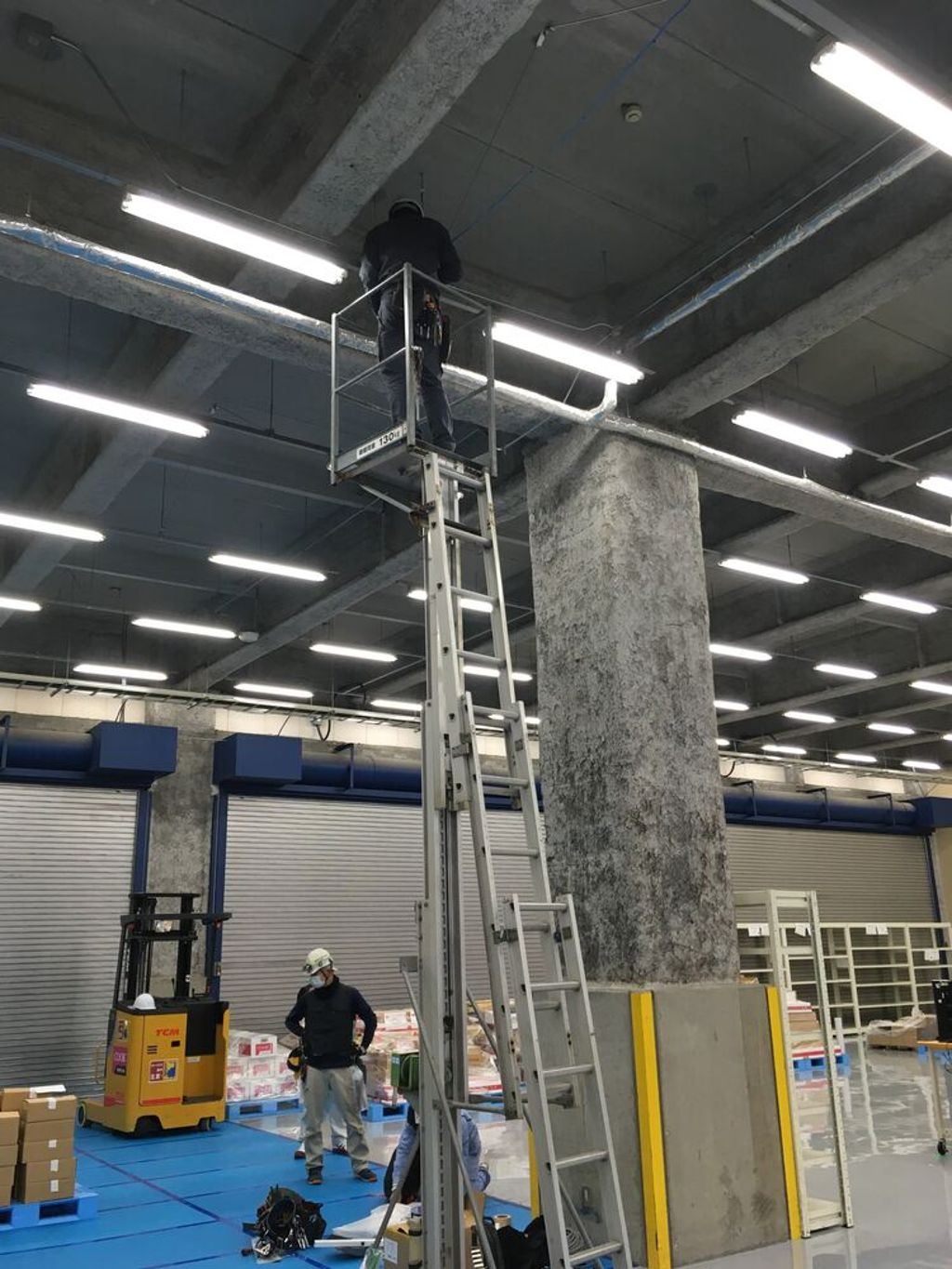
Working at height to run cabling to the ceiling grid — a live warehouse fit-out in Greater Tokyo.
Photo: eSolia Inc.
An office and a warehouse look like the same job from a distance — network, servers, PCs — but on the ground they are not. A warehouse floor is a hostile radio environment full of steel racking, moving forklifts, and metal-walled cold rooms, so Wi-Fi has to be surveyed rather than guessed. Operations run on barcode scanners and label printers, not spreadsheets. And unlike a back-office system, if the warehouse goes down, trucks stop and orders miss their cut-off. We have been doing this work in Japan since 1999 — many of our clients run warehouses in the East Tokyo logistics belt — across greenfield builds, moves, expansions, troubleshooting, and shutdowns.
The Full Lifecycle
Warehouses don't stand still, and neither do the IT projects around them:
- Greenfield setup — standing up a brand-new facility from an empty shell
- Move — relocating operations to a larger or better-located building with minimal downtime
- Expansion — adding floor area, racking, or a mezzanine and scaling the network to match
- Troubleshooting — coming in when scanners drop off the network or an EDI feed stops flowing
- Shutdown — decommissioning a site cleanly, including data and equipment disposal
Because we cover the whole lifecycle, we can carry context forward. The team that cabled your machine room understands it when you expand two years later.
We Work as Part of a Task Force
Warehouse projects are never IT-only. There is a general contractor pouring floors and hanging lights, a logistics team specifying racking and the warehouse management system, a facilities team worrying about power and HVAC, and your own IT — often overseas. eSolia typically joins as part of that task force, owning the IT scope while coordinating in Japanese with the trades and vendors on site and reporting back to your headquarters in English. That bilingual bridge is our niche: every of our professionals works in both Japanese and English.
What We Handle On Site
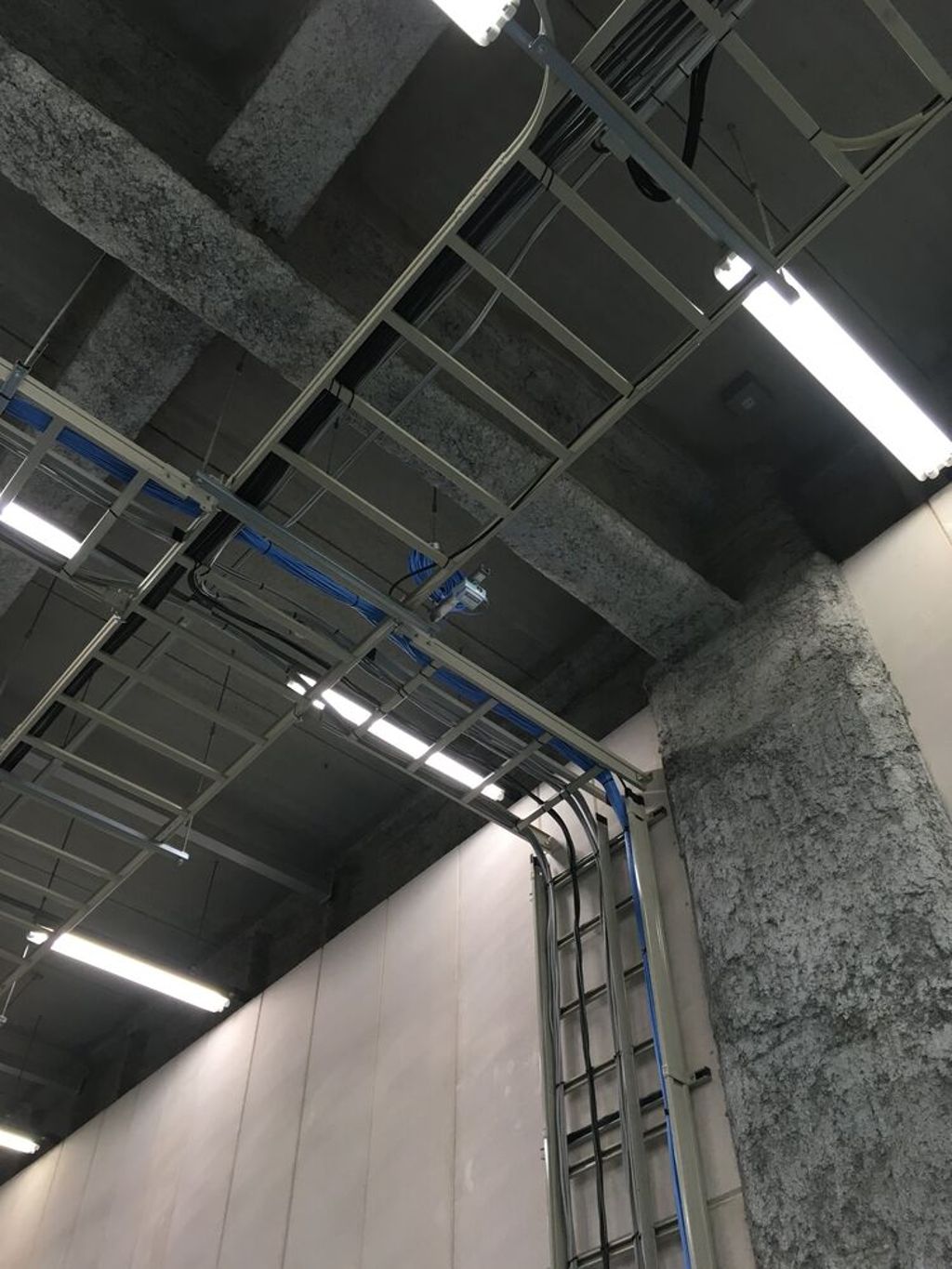
Structured cabling on overhead tray — the LAN backbone routed to the ceiling grid and dropped down columns.
Photo: eSolia Inc.
Inside the building, our physical scope covers the foundation the warehouse runs on:
- Project management — IT and, where you need it, the broader project. Schedule, budget, vendor coordination, and standards documentation.
- Wi-Fi survey and setup — a proper site survey for a warehouse RF environment, then access points and controllers sized for full-floor scanner coverage including racking aisles and cold storage. Freezer rooms often need panel-type antennas where a standard access point won't hold a signal.
- Structured cabling — backbone and horizontal cabling deployment across the office area, floor, and machine room, run to standard and documented.
- Server and machine room build-out — the room itself, racks, power, cooling, and the servers or edge appliances that live in it, braced to Japan's seismic requirements, with enterprise UPS to keep the network and distribution systems up through a power event.
- IT equipment deployment — PCs, network switches, and warehouse-specific hardware such as handheld and mounted barcode scanners and label printers, procured, staged, imaged, and installed. We also handle the network and print integration for automated storage-and-retrieval systems (shuttle / AS-RS units).
The scale ranges from a mini-LAN for a rack rearrangement to a full multi-floor build — a recent warehouse deployment came to roughly 50 access points and 20 print stations across several floors. Japan's fire code also drives its share of this work: rule changes can force a floor to be re-partitioned, which means the network gets re-run to match.
Connecting the Warehouse to Your ERP
The other half of a warehouse project is software: getting the warehouse subsystem talking to the ERP that runs your business. This is an EDI problem, and we have solved it several times at every level of sophistication:
- Simple file exchange — electronic files moving over SFTP on a schedule. Reliable, auditable, and often exactly enough.
- Secure API — a more robust, closer-to-real-time connection over a secured API when the business needs it.
- Industry VAN — connection through a value-added network where your trading partners or industry already standardize on one.
Whichever the transport, these links carry the electronic documents a warehouse lives on — order fulfillment / pick-pack-ship data, RMA (returns) data, and shipping-statement data — flowing between the warehouse subsystem and your Japan or overseas HQ ERP, and they integrate with shipper systems so labels, tracking, and manifests line up. We've built these both as standalone connections and as part of a full ERP rollout — including replacing a legacy back-end and standing up its EDI layer. We scope the data flows, build and test the connection, and document it so it can be operated after we hand it over.

The order to fulfill flows down through the EDI connection to the warehouse; the confirmation that it shipped (ASN, RMA, stock) flows back to the ERP. Whether it runs over SFTP, a secure API, or an industry VAN, eSolia builds and operates the connection in the middle.
Japanese on the Floor, English to HQ
On a warehouse floor in Japan, the general contractor's foreman, the racking installer, the electrician, and the building's facilities manager all work in Japanese. Your ERP team and your management report in English. Most of the friction on these projects is not technical — it is a spec that got lost between those two worlds. We conduct the on-site meetings and vendor negotiations in Japanese, then report status, risks, and decisions to your HQ in English, so nothing falls through the gap.